Showing posts with label UMAI. Show all posts

Wednesday, June 18, 2014

Salumi lombo di manzo

Salumi Lombo Di Manzo is just a fancy way of saying Salami Loin of beef in Italian. What can I say I like funky crazy sounding names that sound appealing. So what exactly did I want to create? Well in a different blog titled Salumi Filetto di Manzo I wrote about my experimental Salami that was created from the center cut of a Beef Tenderloin. It was an experiment that yielded some great results. So with that in mind I wanted a sequel to this incredible Salame with a different cut and with the same great flavor. When I made the Salame from the Tenderloin it encapsulated everything I was looking for with the exception of cost to yield ratio. I produced a Salame that cost about $57.00 a pound to make that was very small. So with all that in mind I decided to test a variant of the original recipe with some tweaks and slight improvements to my technique. 


Short definition of the Loin. The whole loin is divided into two main parts. The Short loin, which includes the choice tenderloin and the top loin (which we are using here) and the sirloin which lies closer to the rump. 


Some names you might be familiar with. The strip steak is know internationally as a club steak. Every where in the US it's called a New York except for New York. 


I purchased a 15.14 lb (6868g) Loin at Costco for $5.69 a pound. After trimming the Loin I yielded a piece of meat that weighed 7.20 lbs (3264g). I reserved some of the scraps and I was able to save 2.14 lbs (1020g) of meat scraps and 2.1 lbs of fat. The scraps will be used later on for sausage. Overall I did very well. Ultimately it will be the taste of the Salame that will judge whether or not I was successful or not. However, when you compare this Loin experiment to the Tenderloin one I think I hit a home run on the price.

Note 1: The weight of meat plus fat is 100%. All ingredients to be added are expressed as a percentage of the weight of meat plus fat. Percentages can be used to standardize recipes regardless of batch size.  All weights are metric. 

Note 2: No weights are given because the weights of meats vary. Everything is a percentage of the meats weight after trimming. Example- Meat weight 2393 grams and we want to find out the amount of salt we need in grams- 2393 X 3.5%=83.755 or 2392/100 X 3.5 =83.755 grams. 


NOTES ON CURING

With this Salumi I chose to do things just a little different than the Salame Filetto di Manzo.   One thing I did different was to add the cure first (Salt and cure #2) on to the meat first. This way I know the meat will have 100% contact with the cure. I think this is a good way to guarantee that the cure will make its way down into the meat. 

In this recipe I changed the percentages of ingredients a bit too. I used a higher percentage Red wine, Red pepper and I used Garlic powder instead of granulated garlic. Instead of adding wine to bag I chose to add it to the meat, herb and spice mixture and massaged it into the meat.  


Salt and cure thoroughly massaged into meat. 


All the spices mixed up and massaged into meat.


The wine I chose to use. 

I poured the wine over the meat instead of pouring into bag. Much better technique.


All vacuumed sealed up and will cure between 21 and 25 days. 


After 24 days meat is cured and ready for the drying application. 

I decided to try something new this time and dust the meat with some spices. I combined in equal amounts, Black pepper, Cayenne, Garlic powder and Smoke paprika.  


MEAT SEALED IN UMAI BAG.


Tied up to maintain shape during drying. 
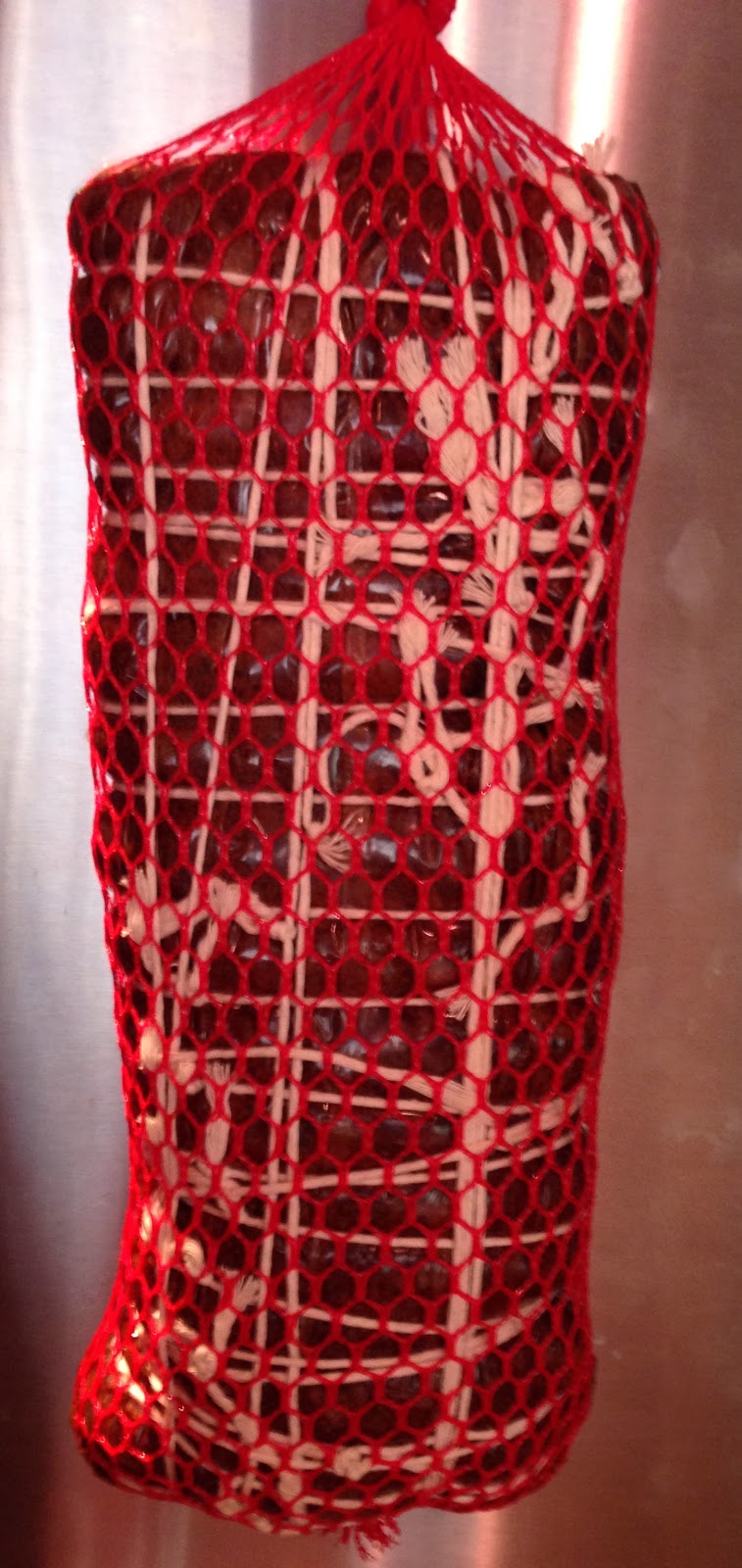


Netted to help keep shape.

Weight 3158 grams. It needs to lose 30% of its weight which is 947.4 grams. At 2210.6 grams it will be ready to be eaten. 


After 986 grams loss (final weight 2190 or 4.82 lbs) which is just barely over 30% weight loss the Salame is done. This Salame too almost 3 months to do and it was worth the wait and expense. I will make this again!!!!!!


A thing of beauty!!! The flavor is intense and spicy!!!


Slicing it up. 


Tuesday, June 17, 2014

Salumi filetto di manzo

Salame filetto di manzo. Just a fancy way of writing in Italian Salumi beef tenderloin. I am spending so much money on this I wanted it to sound fancy. This is the center cut of the mighty beef tenderloin!!! Not know for its flavor but its tenderness. Also a very lean piece of meat too.  

What is a tenderloin? The tenderloin is
an oblong shape spanning two primal cuts. 
The short loin and the sirloin.  
The tenderloin sits beneath the ribs next to the back bone.  It has two ends, the butt and the tail. The center cut is used primarily for the very familiar Filet Mignon.  It is also used for Chateaubriand and the famous Beef WellingtonWe are interested in the center cut or at least I am because I am going to make a very expensive Salumi from this piece. I purchased my Tenderloin from Costco.  


This Salumi project came to me in a dream.  I wanted to make something different , something knew and something I have never seen or read about. 

As I put my thoughts to this blog the Center cut Loin is sitting in
my refrigerator curing. It will cure for 14 days. As of right now I have know idea how it's going to turn out. 

I started this Salumi project started on Jan 4, 2014 which just so happens to coincide with my birthday(finished curing on Jan 18). This is my present to my self. Check out the big bad boy Tenderloin, it's huge. 


I have to trim down the whole Tenderloin to just the center cut.

Again all I need is the center cut and rest will be incredible stew meat or maybe a small roast.

  
To be honest I have never butchered a tenderloin before so I turned to YOU-TUBE to learn how to do it.  


After I butchered it this is what I was left with.  I will be using the additional meat for a scrumptious beef Hodgepodge that I am planning.  So what did I learn from doing it my self.  
That I need to do it several more times.  I did OK for my first time out but I could have done a better job!! 

The Final numbers were as follows. The whole untrimmed Loin weighed 7.29 lbs or 3298 grams.  After trimming the center cut weighed 2.16 lbs or 980 grams. Based on my estimates I think this Salame will cost me about 43 dollars a pound. I hope it's worth it. 

I did not want this Salame looking or tasting like a Bresaola so I decided to come up with my own unique flavors. Again while sleeping (yes I dream about food) I started brainstorming while I was sleeping and than it hit me. I love Italian sausages and their flavors so why not use some of those ingredients in this Salame and that's exactly what I did. 


Note: No weights are given because the weights of meats vary. Everything is a percentage of the meats weight after trimming. Example- Meat weight 2393 grams and we want to find out the amount of salt we need in grams- 2393 X 3.5%=83.755 or 2392/100 X 3.5 =83.755 grams. 


I combined all the above ingredients and placed them in a container. I than massaged the meat with mixture.


The meat is all vacuumed up and will sit in the refrigerator until Jan 18 which will give it 14 days to cure. 


Today is Jan 18 and the curing process is complete. I am going to rinse off the Tenderloin and get it ready for the drying process. 

All rinsed off ready to get vacuumed sealed in side my UMAI drybag 


All vacuumed sealed and ready to be tied.


ALL READY FOR THE LONG DRYING PROCESS.
It weighs 980 grams and must lose at least 30% of its weight.  30% of 980 is 294.  Target final weight for the Salame will be 686 grams. 

Today is Feb 9, 2014 and the Salame filetto di manzo hit the magic number of 686 grams which came out to a 30% weight loss.  If you look closely you can see the dark mahogany color that the filet took on and the obvious weight loss. 


Now on to the taste profile. One of the best tasting whole muscle Salamis I have ever eaten. Now I am not just saying this because I made it either. If it tasted like crap I would be honest about it. The Salame melted in my mouth and the flavor was subtle and smooth. Moister than my Bresaola and richer too. The most delectable Salami I have ever eaten. 

It tasted like a cross between a Genoa salami and an Italian sausage but much milder. I was shooting for the Italian sausage and was not planing on the Genoa salami profile but it came out delicious.  


In the end this thing cost about $62.44 (just the meat) dollars a pound to make and I think it was worth it. I may try a different cut next time out of curiosity.  I might try a whole Loin next time.  

About the cure.....Next time instead of mixing the cure and spice/herbs together I think will apply the cure first than the spice/herb mixture. There were so many herbs and spices I had concerns that the cure did not reach the whole muscle but in the end it did. To alleviate my concerns I will apply cure first just in case. 


Jewish Chorizo?


So why did I call this Jewish Chorizo

First you have to understand two things about Chorizo and Treif. 

Chorizo is traditionally made from Pork, and Treif  is all food that is un-kosher or in laymen's terms unfit for consumption. In addition since I am Jewish and the author of this recipe I thought it was a catchy title.   

I will briefly describe what Chorizo is and what my plans are for this Salumi. Chorizo is from the Iberian Peninsula and mostly associated with the Spanish culture. It can be made with several varieties of meat but predominately it is made from pork. Its a very spicy Salumi/Sausage that can be prepared several ways. I chose to dry cure my Salumi instead of the fresh variety. Fresh Chorizo is OK but the dry cured version is the bomb in my not so humble opinion.  


How do you make make Dry cured Salumi's? Well this is my first attempt. I have made plenty of fresh sausages in my time and even the smoked versions requiring Prague Power #1 but never this type of Sausage or Salumi. I consulted many blogs and several books to help with the science. The recipe is all mine and with my own spin. 

Important steps in Making your Salumi

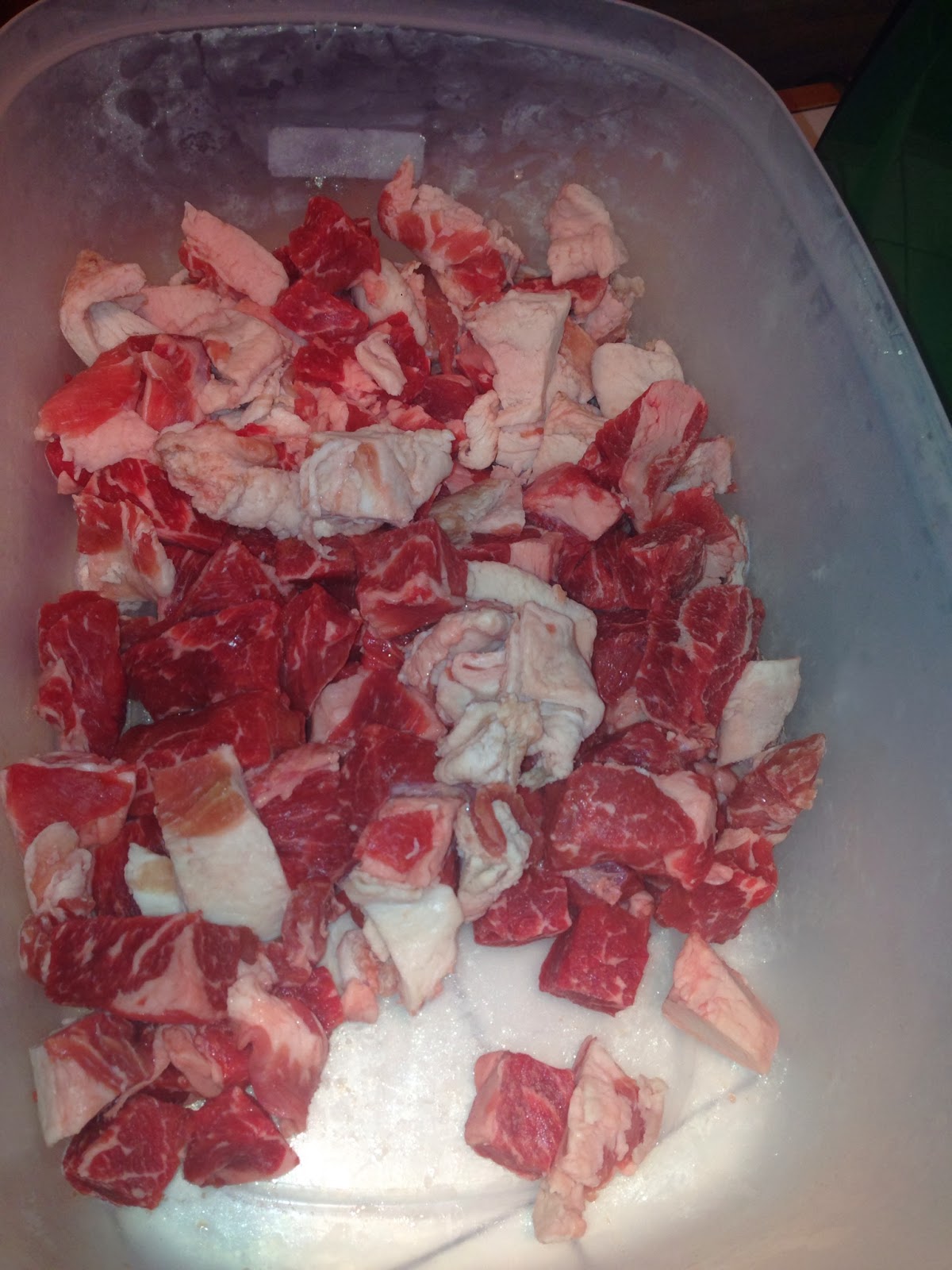
First thing you need to do is choose your meat. I chose boneless short ribs and for the extra fat I needed I chose brisket. 


I kept the meat extremely cold which makes it easier to cut. I cut the meat into one inch pieces than partially freeze the meat which makes it easier to grind.   

After the meat is ground up I give it a quick toss to incorporate the two types of meat than place the meat back into the refrigerator to push temp below 37 degrees. It's important to keep meat out of the danger zone at all times which is 40-140 degrees.  
I pre-measured all ingredients including Prague powder #2 using Milligram scales or this Milligram scale. These scales are not expensive either so pick one up. 


Note 1: The weight of meat plus fat is 100%. All ingredients to be added are expressed as a percentage of the weight of meat plus fat. Percentages can be used to standardize recipes regardless of batch size.  All weights are metric. 

Note 2: No weights are given because the weights of meats vary. Everything is a percentage of the meats weight after trimming. Example- Meat weight 2393 grams and we want to find out the amount of salt we need in grams- 2393 X 3.5%=83.755 or 2392/100 X 3.5 =83.755 grams. 
After the meat temp has come down a bit I mix all the ingredients with the exception of the Culture. I mix the meat quite aggressively to ensure the incorporation of all ingredients. I than add diluted culture to the meat and knead the meat until firm and everything is thoroughly mixed. 

T-SPX CULTURE 
Tec Specs

.012537% to meat weight

If your using 10 lbs of meat mathematically 
10 lb = 4535.92 grams
.012535% X 4535.92 grams = .57 grams or 1/2 tsp


  • Technical information sheets provide the recommended temperatures for fermentation, however, bacteria will also ferment at lower temperatures, just more slowly. For example, the technical information sheet for T-SPX lists temperatures as 26-38º C, optimum being 32º C. T-SPX will ferment as well at 20-24º C which is not uncommon for "European" style sausages, and 48 hours or more is not atypical.
  • When freeze-dried cultures are used it is recommended to disperse them in water. Adding 25 grams of powdered culture to 200 kg (440 lbs) of meat makes uniform distribution quite challenging. That comes to about 1/2 teaspoon to 4.5 kg (10 lbs) of meat and the culture must be very uniformly dispersed otherwise defects will occur later on. For those reasons it is advisable, especially at home conditions, to mix 1/2 tsp of culture in 1/2 cup (150 ml) of distilled water and then pour it down all over the meat. Any tap water which is chlorine free will do, the problem is that different cities, or countries, sanitize water in different ways. Chlorine will kill bacteria and the process will suffer. For this reason it is recommended to use distilled water.
  • Mixing freeze-dried cultures with cold water for 15-30 minutes before use allows them to "wake up" and to react with meat and sugar faster when introduced during the mixing process.
  • Cultures distributed by Internet online companies are of the freeze dried type.
  • Once fast-fermented starter culture or Gdl has been added to the sausage mix, the mix should be filled into casings.


I used a Sausage Maker Stuffer  as my stuffing apparatus. It's a great inexpensive little stuffer that gets the job done. I have had mine for about 15 yrs. 
Now on to the bags. Since I do not have a traditional curing chamber I am once again using a UMAI dry bag for my Charcuterie. 


After three days of fermenting the Chorizo is now ready for the cooler. The Chorizo will lose 30% of their weight. 


After 7 days the Chorizo lost 17% of its weight. Looks great. 


I wrote about my desire to make a Chorizo without Treif and I am happy to report that I completed my project and it came out great!!!  

Look at these pictures!!! Outstanding looking Chorizo if I do say so my self!!!


 After a long wait of only 24 days the Chorizo lost 30% of its weight.  I used the UMAI drybags to tackle the boundaries of Charcuterie


As you can tell from the photos these bags allowed me to make great charcuterie!!!!


Next Batch will be bigger and spicier!!